
XV Edition Video Sound Art Festival
Never Ground
Milan, 28 – 30 November 2025
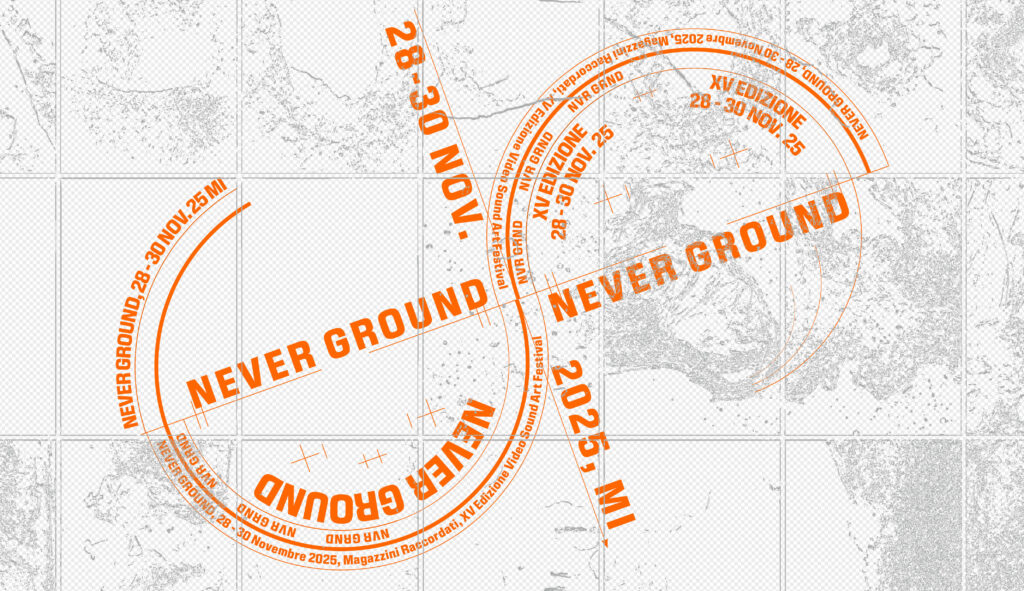
From 28 to 30 November 2025, Video Sound Art Festival returns with its 15th edition, titled Never Ground: an important milestone marking fifteen years of activity in the production and promotion of contemporary art.
This year, the Festival once again reaffirms its mission to explore the relationship between contemporary art and exhibition spaces located outside traditional circuits, choosing a new venue in the city of Milan: the Magazzini Raccordati, in the tunnels of Central Station.
The location is deeply connected to the theme of the 15th edition: the underground understood as both a physical place and a symbolic threshold—a metaphor for the voices that throughout history have been submerged by structures of power, a gateway to initiatory descents, a place of metamorphosis.
The Festival takes its title from Never Ground, a new work by Natália Trejbalová, produced by Video Sound Art and created with the support of the Italian Council program promoted by the Directorate-General for Contemporary Creativity of the Italian Ministry of Culture. The work will enter the collection of Museion (Bolzano).
Acting as a resonating chamber, the Festival amplifies and deepens the theoretical implications of the artwork, developing them through a series of thematic expansions. Recent scientific research has revealed how life can adapt to extreme conditions, prompting us to reconsider the very limits of existence. Subterranean ecosystems, resilient bacteria, and life forms that challenge our understanding: exploring the depths of the Earth means opening ourselves to new biological models — perhaps even to clues about other forms of life in the universe.
In dialogue with Natália Trejbalová, the Festival will also feature works by Adele Dipasquale, Nicoletta Grillo, and Andrea Mauti.
Natália Trejbalová
Never Ground

Natália Trejbalová, Never Ground, Full HD video, color, sound, 17 min., 2025. Produced thanks to the support of the Italian Council (2024).
Installation view, Never Ground, XV edition Video Sound Art Festival, 2025, Magazzini Raccordati, Stazione Centrale di Milano. Ph. Francesca Ferrari
Read more
Never Ground is a video work inspired by science fiction stories about subterranean worlds and recent scientific discoveries connecting speleological exploration with space exploration. The video is presented as an uninterrupted loop depicting a descent and ascent through the interior of a celestial body, tracing a potential space-time journey between Earth and the underground passages of another planet.
In Never Ground, real ecosystems merge with studio-constructed scenes inspired by pre-digital sci-fi special effects techniques that relied on miniature sets and props. Trejbalová’s research into moving images is closely connected to her sculptural practice, which plays a central role in constructing the cinematic imaginary. The sculptures created by the artist become the film’s sets, bearing witness to a process in which matter is transformed into image.
The video explores the structure of Jules Verne’s novel Journey to the Center of the Earth (1864), in which the protagonists traverse the planet’s interior by entering through an Icelandic volcano and emerging from Stromboli. This nineteenth-century tale conceptually anticipates what future technologies would enable: connecting two extremely distant points on Earth. In recent years, subterranean systems—particularly lava tubes found on the Moon and Mars—have attracted significant scientific interest, as they may be among the first environments suitable for future human settlements. Simultaneously, newly discovered terrestrial cave systems harbor organisms that have evolved under such unique conditions that they provide valuable insights into possible forms of life in extraterrestrial environments.
Addressing the theme of the underground involves confronting a series of critical contemporary issues: the ground beneath our feet harbors the majority of the planet’s fauna and, simultaneously, the remnants of vanished human civilizations. Excavation grants us access to a distant, even deep, past—much like the extraction of minerals and hydrocarbons, which underpin the survival of the capitalist system. Yet, as human beings, we are accustomed to perceiving only the visible surface of our planet, almost as if we inhabit an infinite plane.
The project is supported by the
Italian Council program (2024)
promoted by the
Directorate-General for Contemporary Creativity of the Italian Ministry of Culture. Discover more.


Natália Trejbalová, Never Ground, 2025, Full HD video, color, sound, 17’
Directors of photography: Matteo Pasin, Andrea Pocorobba. Editing: Natália Trejbalová, Valeria Corà. Music, mix, and mastering: Giuseppe Ielasi. Vocal improvisations: Adele Altro. Producers: Laura Lamonea, Alma Malara, Federica Torgano. Colorist: Matteo Finazzi. Lighting assistant: Stefano Trombetta. CGI background images: Diego Zuelli. Title design: Gloria Favaro. Courtesy of the artist. Produced with the support of the Italian Council program (2024).
Natália Trejbalová, a deep crack, the fall through and the descent into the abyss, 2024, polystyrene, acrylic ink, sand, clay, various materials, variable dimensions. Courtesy of the artist. Produced with the support of the Italian Council program (2024).
Natália Trejbalová, Travelling without moving, 2024, paraffin, acrylic ink and various materials, iron basin, 90 × 50 cm
Natália Trejbalová, accelerando, 2022–2025, paraffin, beeswax, acrylic ink, salt crystallizations, LED light and various materials, iron stand, 110 × 140 cm
Natália Trejbalová, Fantastic Voyage pt. 1–3, 2025, paraffin, beeswax, acrylic ink and various materials, iron stand, 35 × 140 cm
Adele Dipasquale
Spirit Talks

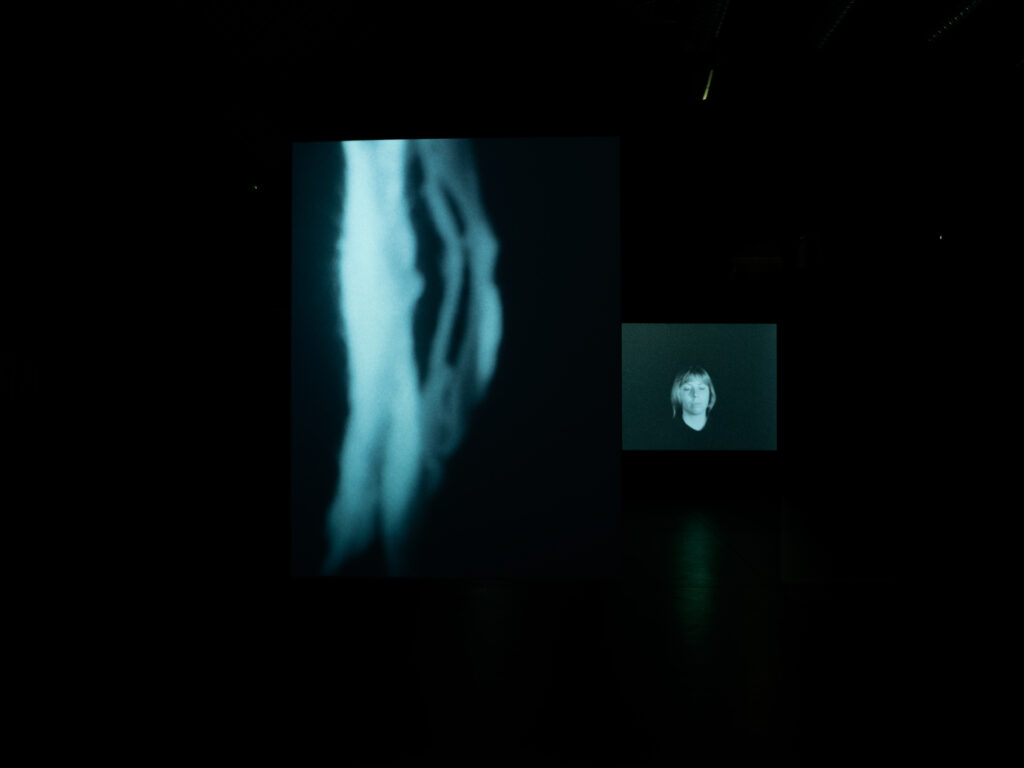
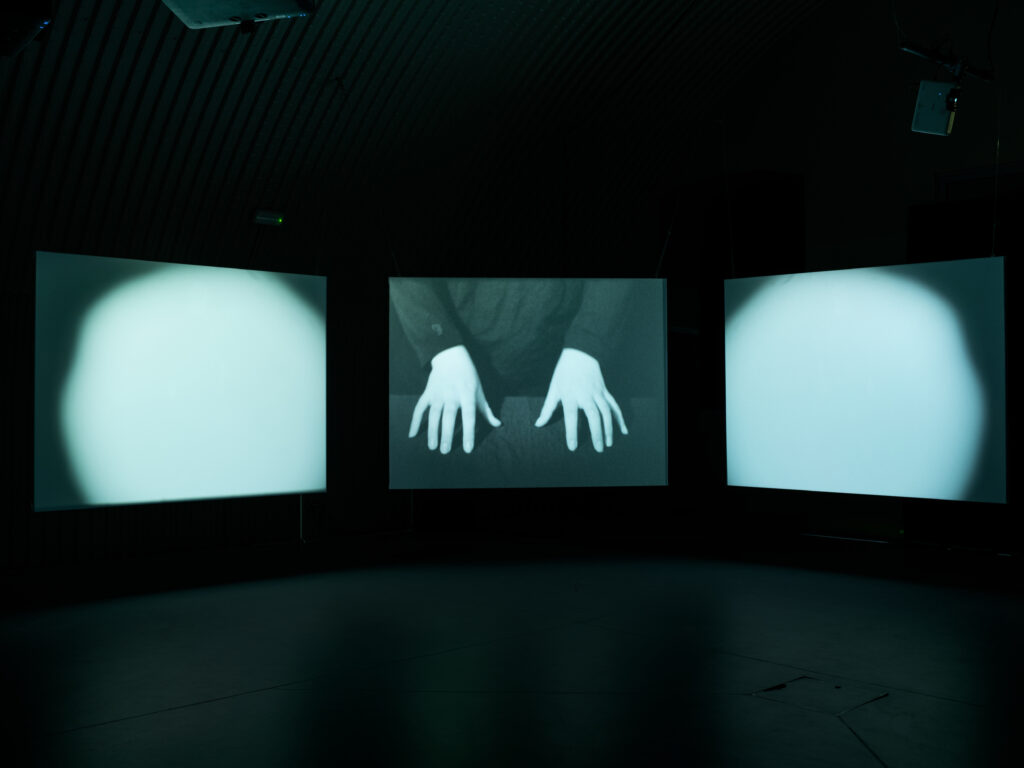
Adele Dipasquale, Spirit Talks, 2022–2025, multichannel installation, Super 16mm film scanned in 2K, 5’ loop
with Cristina Lavosi, Angelica Venturini, and Adriana Marineo. Sound: Marco Segato. Editing: Benedetta Marchiori. Assistants: Cristina Lavosi, Marco Quadri, and Adriana Marineo. Film stock: Kodak. Film processing: Filmwerkplaats Rotterdam, Onno Petersen, Color DeJonghe. Supported by the Mondriaan Fonds Voucher in 2024.
Installation view, Never Ground, XV edition Video Sound Art Festival, 2025, Magazzini Raccordati, Stazione Centrale di Milano. Ph. Francesca Ferrari
Read more
What does it mean to be a channel for someone else’s voice, to embody that voice as in a séance? If mediumship is a matter of tuning in, then I would say it can be a privileged mode of knowledge—a way of relating to and communicating with the world. I approached evocation as a form of invocation, a way of feeling indebted to the voices of the past—those whose memories have been forgotten, silenced, or suppressed.
Adele Dipasquale
Spirit Talks is a multichannel installation derived from a series of short 16mm black-and-white films. The work is based on extensive research into nineteenth-century mediums—women who were often marginalized and who, through their mediumistic practices, found forms of economic and symbolic self-determination. In the late 1800s, alongside the rise of photography, there was a surge of interest in spiritualism. During this period, many mediums attracted the attention of the positivist scientific community, which sought to use photography as a tool to prove or disprove supernatural apparitions. Scientists focused on invisible phenomena—such as electricity, the unconscious, or spirits—in an effort to classify and name what exists.
Spirit Talks reclaims early analog special effects techniques, such as double exposure and optical découpage, to create spectral presences on screen and highlight the historical tension between positivist science and magical thought. The sound component, developed in collaboration with a sound artist and the performer, explores the “improper” use of the voice, evoking a dimension where what has been silenced can once again be heard.
Andrea Mauti
Esausta
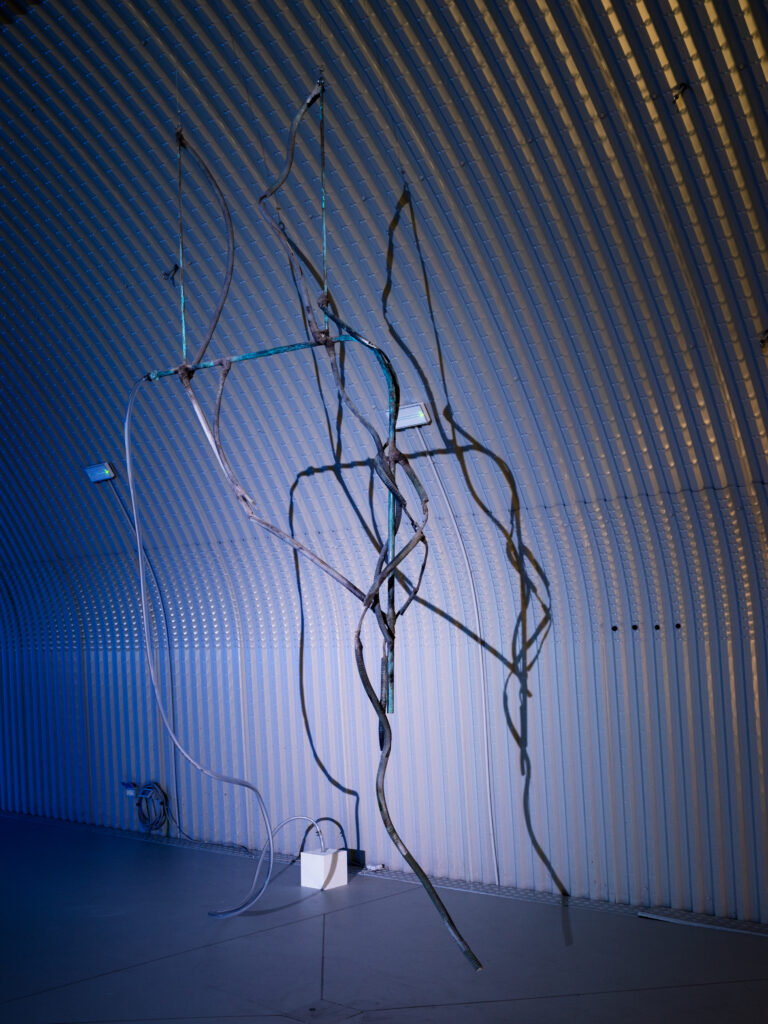
Andrea Mauti, Esausta (Voices Voices), 2025, site-specific installation, copper, ashes collected from the firing of clay objects, plaster, iron oxide, soil from the Caffarella Park (Rome), charcoal, fennel essence produced by the artist, steam
Installation view, Never Ground, XV edition Video Sound Art Festival, 2025, Magazzini Raccordati, Stazione Centrale di Milano. Ph. Francesca Ferrari
Read more
The Etruscan rite of haruspicy involved reading the entrails of animals—usually sheep—by extracting the intestines and liver to establish a physical connection with the world of the afterlife. Esausta (Voices Voices) awakens collective memories in which death is both condemnation and repression, as well as a silent presence that continues to inhabit spaces. Esausta evokes a death-stricken body that breathes, consumed by pain, hollow like the tubes through which the gaseous specter of fennel essence permeates the space.
The memory of the dead is evoked through smell—an invisible medium capable of triggering and recalling traumatic events. In Michela Zucca’s text Donne delinquenti, the word “finocchio” (fennel), in Italy now misused as a slur related to sexual orientation, is traced back to the hanging practices inflicted upon women accused of witchcraft. Meanwhile, the bodies of homosexual men were used to fuel the fires that burned the condemned women. After the hangings, the corpses were sprinkled with fennel seeds to mask the smell of decay and burning.
The work appears as an intestinal, robotic creature whose materials absorb the diffused essence, creating a collective ritual moment in remembrance of bodies, identities, and species that no longer exist yet continue to haunt and remain alive in their corporeal absence.


Nicoletta Grillo
Orizzonte
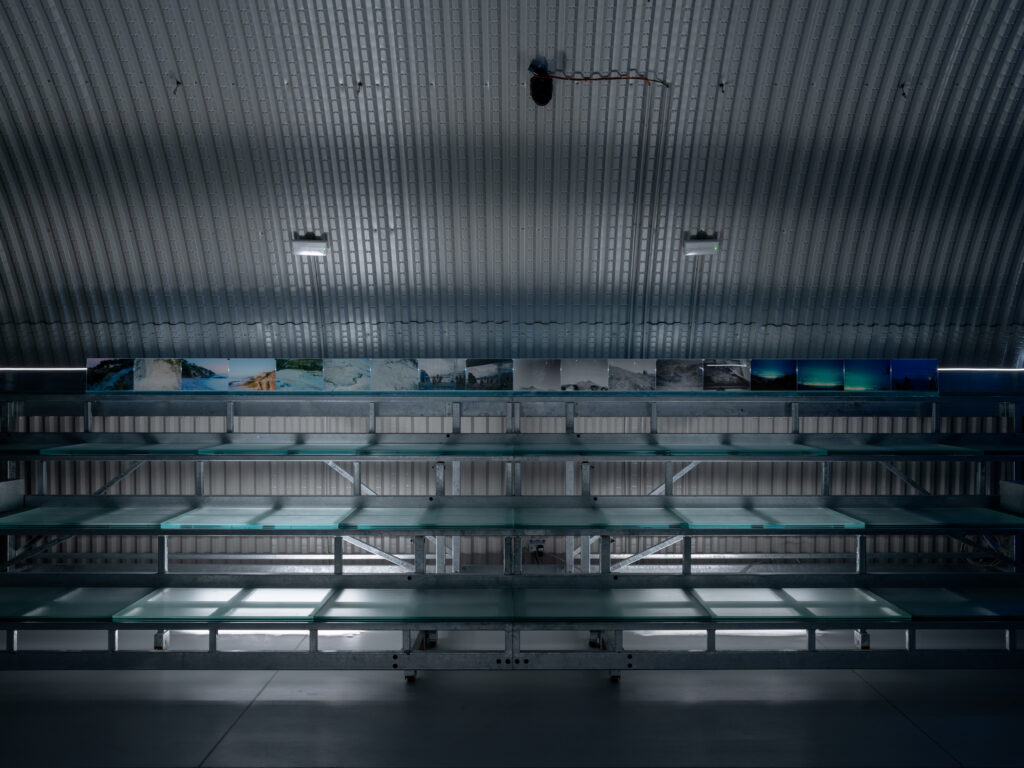
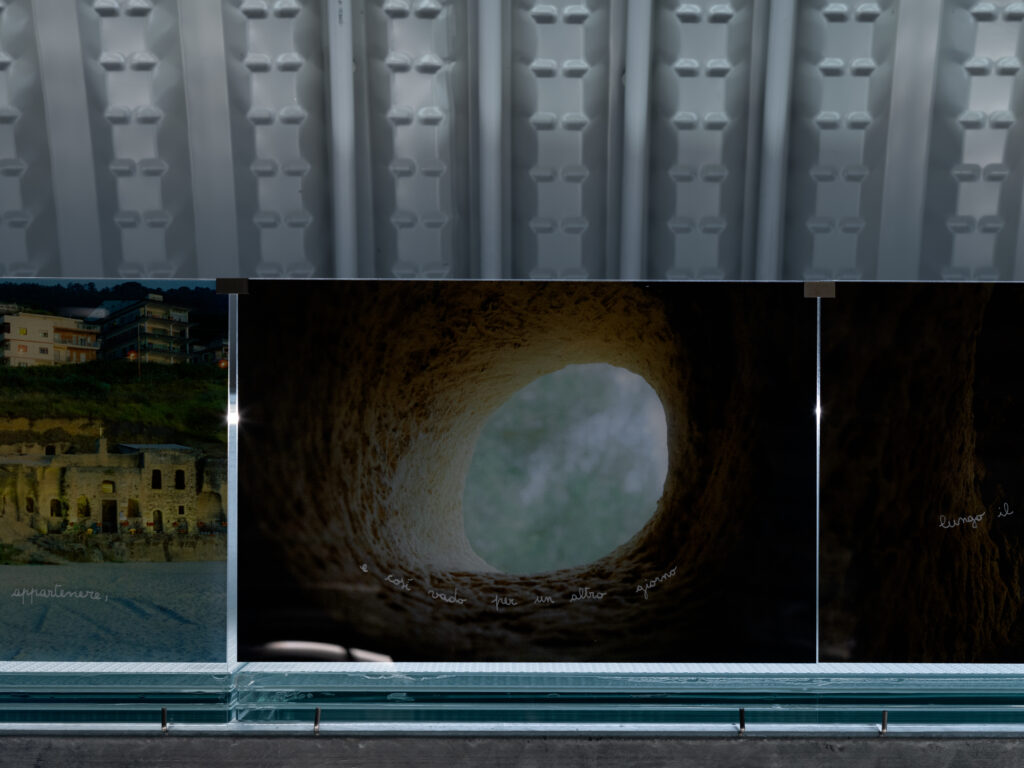
Nicoletta Grillo, Orizzonte, 2025, site-specific installation, inkjet print on plexiglass, marker on plexiglass, 24 × 1296 cm
Installation view, Never Ground, XV edition Video Sound Art Festival, 2025, Magazzini Raccordati, Stazione Centrale di Milano. Ph. Francesca Ferrari
Read more
Orizzonte is a verbo-photographic installation depicting locations in the Tyrrhenian Calabria characterized by the movement of matter and people between the mainland and the sea. The work consists of thirty-six photographs arranged in a continuous sequence, resembling a single film of light, in dialogue with the architecture of the exhibition space. Each image is overlaid with handwritten text in marker, transcribing a passage from Giuseppe Berto’s novel Il male oscuro. The Venetian writer lived for years in Capo Vaticano—a panoramic point from which some of the photographs for the installation were taken. Berto reflects on the fear of crossing the sea in a way that seems to allude to surpassing one’s limits, ultimately concluding by observing the lights on the other side of the coast, toward Sicily. The photographs portray various carved topographies where the subterranean becomes visible: a sand quarry later recognized as a geosite of marine fossils; a church carved into rock by a group of sailors as an ex-voto for surviving a shipwreck; rock caves that once served as grain storage along transport routes and later as stone dwellings. There are also emergent topographies from which matter rises to the surface, such as the two volcanoes, Stromboli and Etna, whose movements have shaped the territory, and the port of Gioia Tauro, a hub of goods along the coastline. Born from visual research for the video project Oltremare (2025), the installation becomes a topographical fable connecting the different layers of a transforming territory, where image becomes text and text becomes landscape.

Public Program
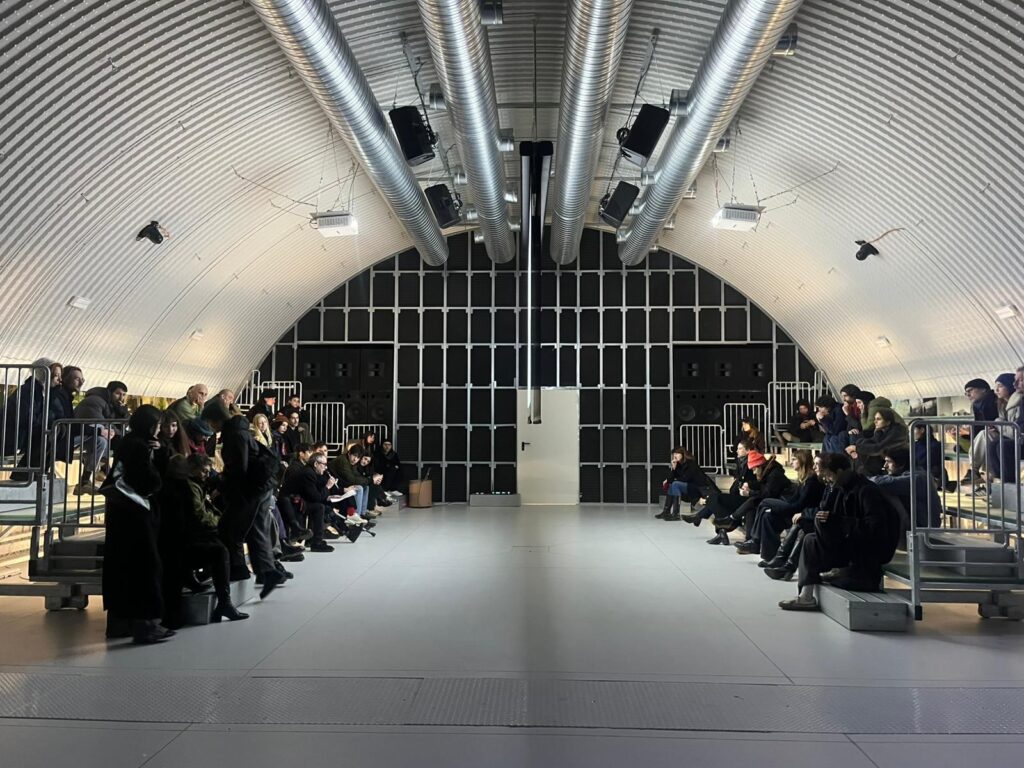
The Public Program of the Festival’s 15th edition, curated by Stella Succi, offers a schedule of meetings, talks, and presentations open to the public—a space for dialogue and speculative experimentation, exploring connections between art, philosophy, and science in order to expand and share the research processes underlying the projects on display.
On Saturday, 29 November, three events will take place in succession. The first will bring together philosopher Paolo Pecere, curator Barbara Casavecchia, and artist Luca Trevisani for a conversation on the relationship between the arts and the underground over time, from prehistoric forms of expression to contemporary practices and imaginaries.
The second talk will involve speleologist Francesco Sauro, microbiologist Martina Cappelletti, and artist Natália Trejbalová. Starting from scientific research and from the artistic and editorial project Never Ground (published and distributed by MOUSSE), the discussion will address the underground as a crossroads between the terrestrial and the extraterrestrial, between deep time and the future.
The program concludes with a performative reading featuring contributions by Altalena, Annamaria Ajmone, Sandra Cane, Ivan Carozzi, Attila Faravelli, Frankenstein Magazine, Medusa, and Murmur—an interweaving of voices and sounds evoking the many forms of depth.
Presentation of the winning project of the 2025 Open Call
Dialogues from the Underground is the title of the Open Call launched by Video Sound Art ahead of the Festival’s 15th edition, curated by Francesca Colasante in collaboration with Pollinaria and TAB | Take Away Bibliographies.
In line with the Festival’s themes, the call invited artists, creatives, and researchers to take part in a residency dedicated to exploring the underground as both a symbolic and a physical space.
The winning project, TUNING FOR RELATIONSHIPS. Practices of Somatic Speleology by Sofia Salvatori, explores the body’s perceptive potential in relation to hypogeal environments through exercises of listening and tuning into the depths of the ground. On Friday, 28 November, during the Festival opening, Sofia Salvatori will share the outcomes of the project in conversation with Francesca Colasante, curator of the open call, and Rita Duina, who will present the new TAB | Take Away Bibliographies fanzine, together with Letizia Scarpello for Pollinaria.
The publication, conceived as an open narrative, interweaves images, notes, and theoretical references, becoming an extension and trace of the collective research process. On the mornings of Saturday 29 and Sunday 30 November, Sofia Salvatori will also lead a workshop in which participants will be invited to “descend” with their bodies—an experience that, starting from an eco-somatic practice, recalls speleological exploration: a movement of listening, softening, and relinquishing verticality to perceive space in an unprecedented way.
XV Edition Video Sound Art Festival
Never Ground
28 – 30 November 2025
Exhibition Guide
Public Program
Open Call 2025
Location:
Tunnel of Stazione Milano Centrale
Magazzini Raccordati, Milan
Via G. B. Sammartini, 38
The project is supported by the
Italian Council program (2024)
promoted by the
Directorate-General for Contemporary Creativity of the Italian Ministry of Culture.
With the support of:
Municipality of Milan
8 per mille Chiesa Valdese
Organization of Regional Importance
Lombardy Region
Artistic Direction
Laura Lamonea
Public program curated by
Stella Succi
Open Call curated by
Francesca Colasante
Communication and Development
Francesca Mainardi, Federica Torgano
Production
Lino Palena
Education
Tommaso Santagostino, Thomas Ba
Press Office
Sara Zolla
Visual Identity
Gloria Favaro, Nicola Narbone