
The Then About As Until is a Video Sound Art project, curated by Laura Lamonea, presented within the twentieth edition of ArtVerona (October 10–12, 2025).
The exhibition explores the relationship between verbal expression and image, starting from the verbo-visual experiments of the 1960s, which led artists from around the world to explore new visual forms of linguistic production. Tracing the legacy of Futurist free-word compositions, Dadaist poetry, Lettrist and Surrealist collages, the verbo-visual artistic context has long been nourished by a multilingual and multidisciplinary dialogue.
The Then About As Until employs rewriting and linguistic experimentation—through its deconstruction and displacement. The works on display—installations, videos, performances—challenge the linguistic frameworks that shape our perception of reality. In this expansion, language becomes a space for collective invention, redefining the very conditions of what we can think and share as social and existential experience.
Linguistic fragments act as bridges between images. Text can become architecture and an instrument for constructing space and time, as in the case of Peter Downsbrough, who in his films uses a plastic vocabulary with an essential and rigorous use of letters and lines.
Words juxtaposed with visual sequences invite the viewer to become aware of themselves in relation to a place.
What appears minimal and silent opens up a profound reflection on public space, the role of the individual, and the individual’s critical stance.
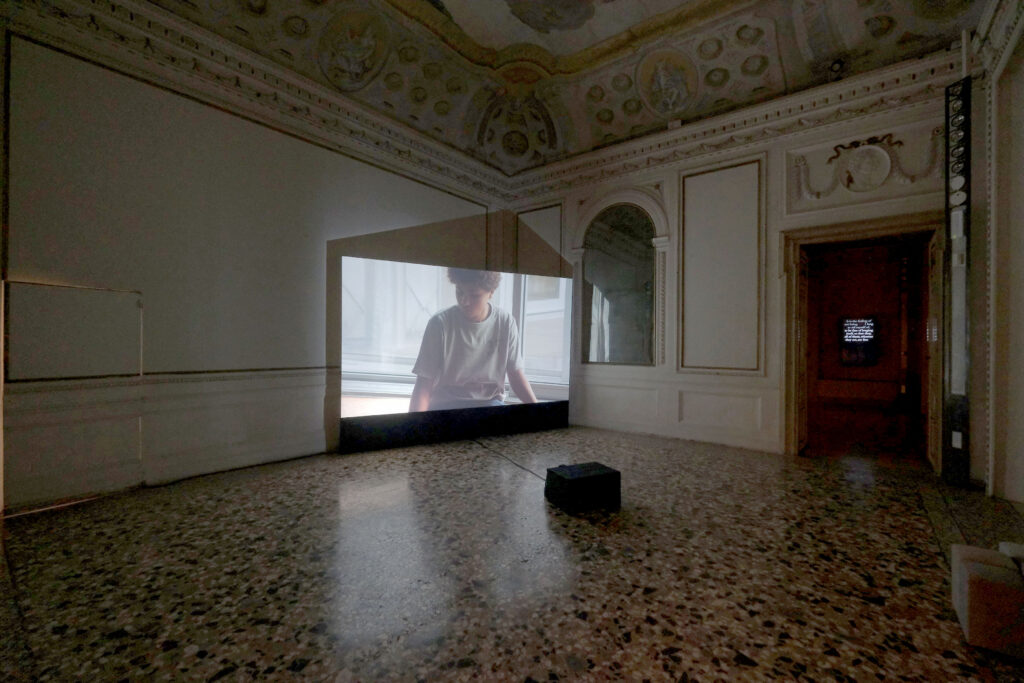
Manon de Boer, Oumi. From nothing to something, to something else, part 3, 2019, HD video, colour, 15 min. Installation view, The Then About As Until by Video Sound Art in the context of ArtVerona XX edition, Palazzo Forti, Verona, 2025. Photo by Ennevi Foto.
Exhibition
Herman Asselberghs
Watching Words Becoming a Film
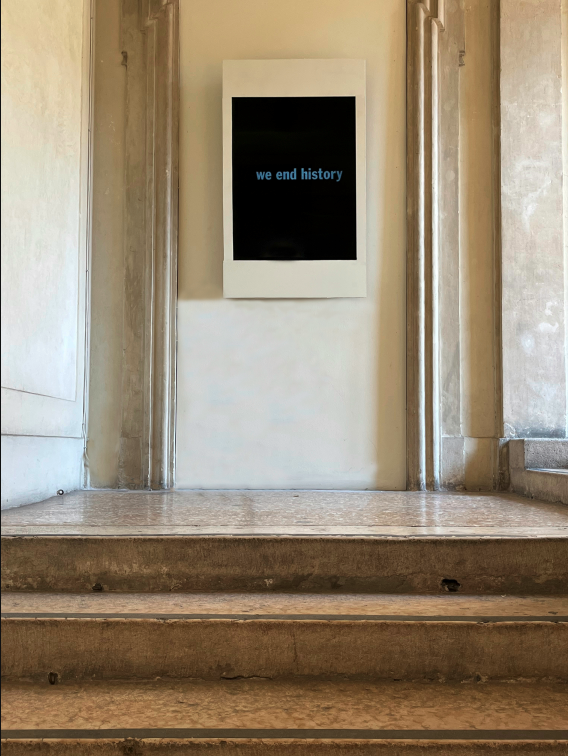

Herman Asselberghs, Watching Words Becoming a Film, 2017, Video, colour, silent, 6’ 13’’. Installation view, The Then About As Until by Video Sound Art in the context of ArtVerona XX edition, Palazzo Forti, Verona, 2025.
Discover more about the work
watching words becoming a film sort of a film
this is a film and these are the words
watching film a film becoming words sort of
word’s out word up word
Over the past decades Herman Asselberghs (b. 1962, Mechelen, Belgium) has meticulously built an audiovisual body of work on the relationship between sound and image, poetry and politics. In Watching Words Becoming a Film, words are repeated on screen like a kind of visual mantra; they appear and disappear one after another with precise timing and careful consideration. They invite the viewer to fill the sonic void with their imagination, as if an invisible echo were giving them voice. A film to be read that initiates a silent dialogue with the spectator, suggesting a reflection on the experience of cinematic time.
Peter Downsbrough
THE OTHER
THERE
AND_04.2020
PASS – ING]
POWER/ FROM, TO, WITH
Two Pipes, One Standing – 27,5 cm
Koln e New York
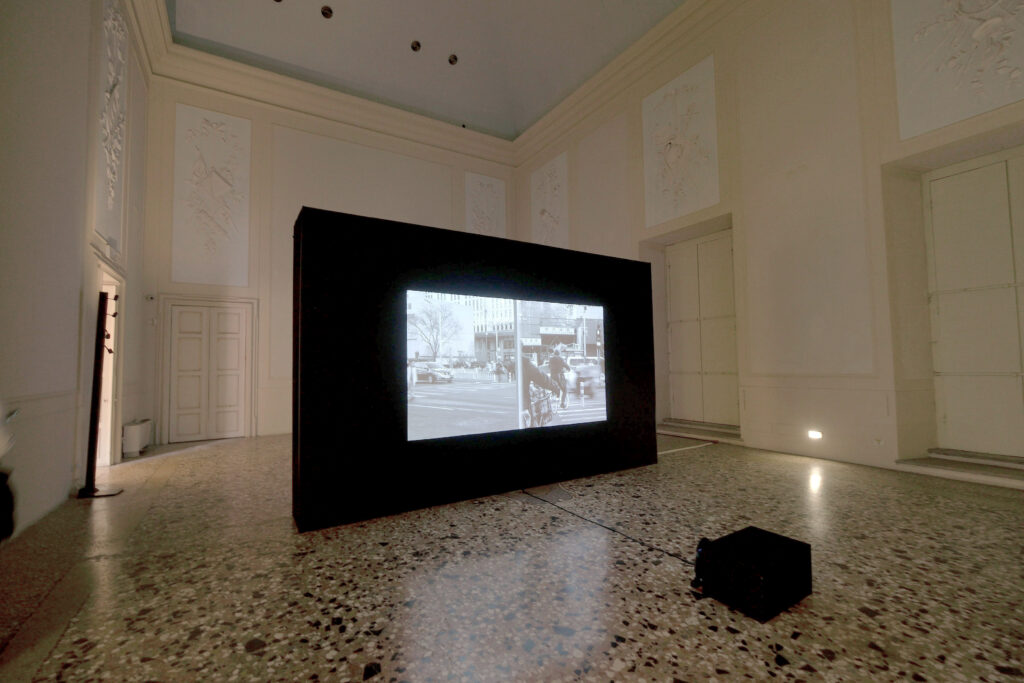
Peter Downsbrough, THE OTHER, 2019, Video, b/w, sound, 2’ 11’’. Installation view, The Then About As Until by Video Sound Art in the context of ArtVerona XX edition, Palazzo Forti, Verona, 2025. Ph. Ennevi Foto.
Discover more about the artist and the works
Lines, words and blocks of color constitute the core of Peter Downsbrough’s plastic vocabulary (b. 1940, Brunswick, USA – 2024, Brussels, Belgium), who conducted his research in constant dialogue with architecture and with the constituent elements of language.
His works form a coherent corpus through a multitude of techniques and formats: spatial interventions or manipulations, urban photographs, maps, sculptures, sound works, scale models, film, works on paper and publications.
“It’s all a matter of space.” — Peter Downsbrough.
The installation of this first room is configured as an extension of the artist’s architectural language: four videos are projected on a structure that frames them and which, like Downsbrough’s lines, not only divides but defines, orients and suggests new spatial possibilities. The words juxtaposed with the images imply a notion of positioning: architecture and language thus become instruments of political interrogation.
In THE OTHER the screen is geometrically divided: glimpses of the city appear through a narrow slit separating two wide black lateral bands. On these surfaces letters and words move, which, as frequently happens in the artist’s work, assume a visual, rhythmic and structural dimension, silently dialoguing with the space of viewing.
THERE makes explicit that every film is a sequence of still images and requires a conscious perceptual effort. Downsbrough offers a portrait of his relationship with time and space. THERE is the first of two “film‐in‐a‐film” pieces, composed of short silent color sequences shot with a fixed camera at two busy intersections in Brussels. In one split-screen scene, the moving image, an urban street of the 2010s, progressively empties, making way for a black and white photograph of a New York street from the 1970s.
This transition marks the start of a sequence of twenty‐three images taken in different urban transit spaces. The two short color films thus frame a visual reflection on time, movement and the perception of space.
AND_04.2020 opens with the voice of a man emerging from the noise of traffic. Shortly after, words appear on screen: the, then, about, as, until. Their juxtaposition is as undecipherable as the man’s words. Made following a brief visit by Downsbrough to Beijing in 2015, the video is a reflection on language and the city, offering a filtered image of the Chinese urban experience: orderly traffic, choreographed pedestrian crossings, but also small gestures of disobedience that break the apparent control. The phrase in time place / the] shift alludes to the economic and political changes of contemporary China and to the artist’s displacement through space and time.
Finally, the title AND_04.2020 suggests that the work does not represent an ending, but forms part of a larger conversation.
PASS-ING] is a work made with twenty traveling shots. The artist’s camera moves parallel to a fence, through an abandoned industrial building where pipes were once produced. The words and, here, as, set and between are incorporated into the video. These connectors are linguistic elements that relate to and discuss the structure of the work itself, the architecture or the language.
In POWER/ FROM, TO, WITH a strip of adhesive tape delimits a portion of wall. What matters is not the object nor its physicality, but the act of redefining. “More than transforming space, it is a matter of interacting with it,” the artist states. “Space is given: someone has organized and designed it, and I have the opportunity to insert an element into it, to establish a dialogue with it and, ultimately, with the people who inhabit it. People see, or they do not see; they have the possibility to choose. My intervention always aims at the smallest possible intrusion.”
Created since the 1970s, the Pipes represent the idea of sculpture reduced to its essential: a vertical line, a minimal gesture that does not define but delimits space. Deprived of a pedestal and sometimes suspended, they introduce a new reading of the relationship between sculpture and place. Their strength is also revealed in absence: when they are removed, the space suddenly seems incomplete. The vertical lines present in the videos of the previous room find here a physical translation in direct relation to the architecture of the place. Each Pipe is made to measure with respect to the environment that hosts it.
Whether noticed or ignored, this calibrated tension is part of the work’s strategy, conceived to provoke a tacit reflection on the relationship between body, gaze and space.
Peter Downsbrough explored the temporal dimension of photography through visual sequences – diptychs, triptychs and editorial series – that evoke the passage of time and spatial displacement, approaching by analogy the language of cinema. The artist builds a kind of photographic montage which, unlike the cinematic montage, is not based on a continuous flow of images, but on intervals and discontinuities: each shot represents a temporal jump and a change of position, inviting the viewer to mentally reconstruct what occurs between the images.
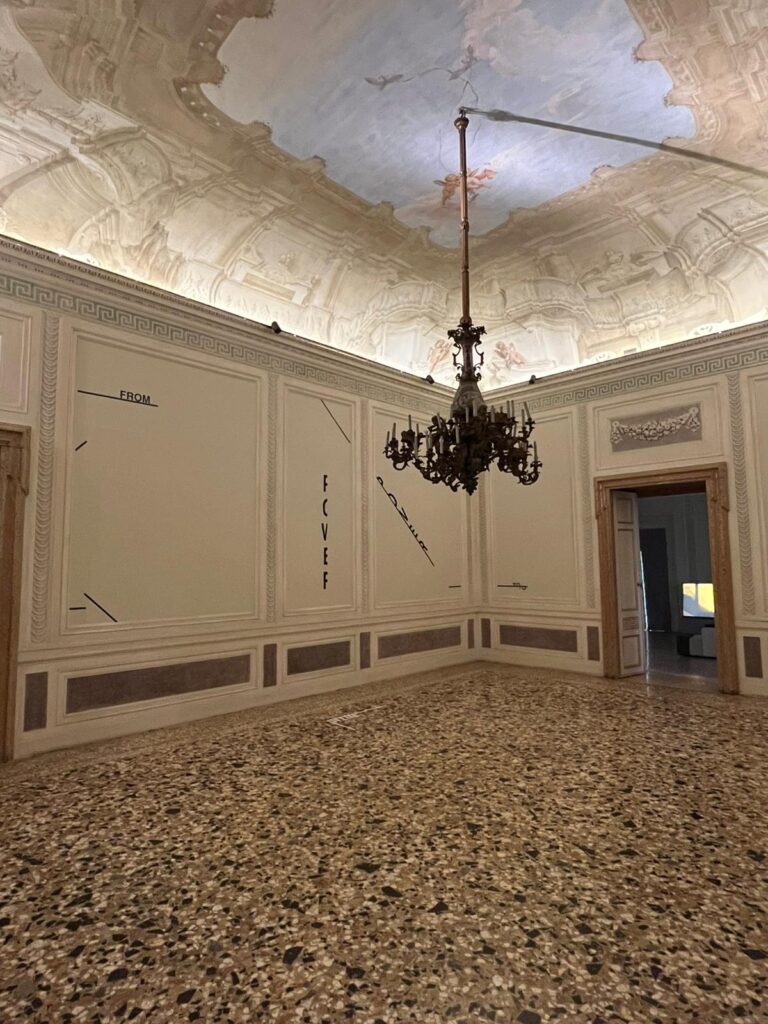
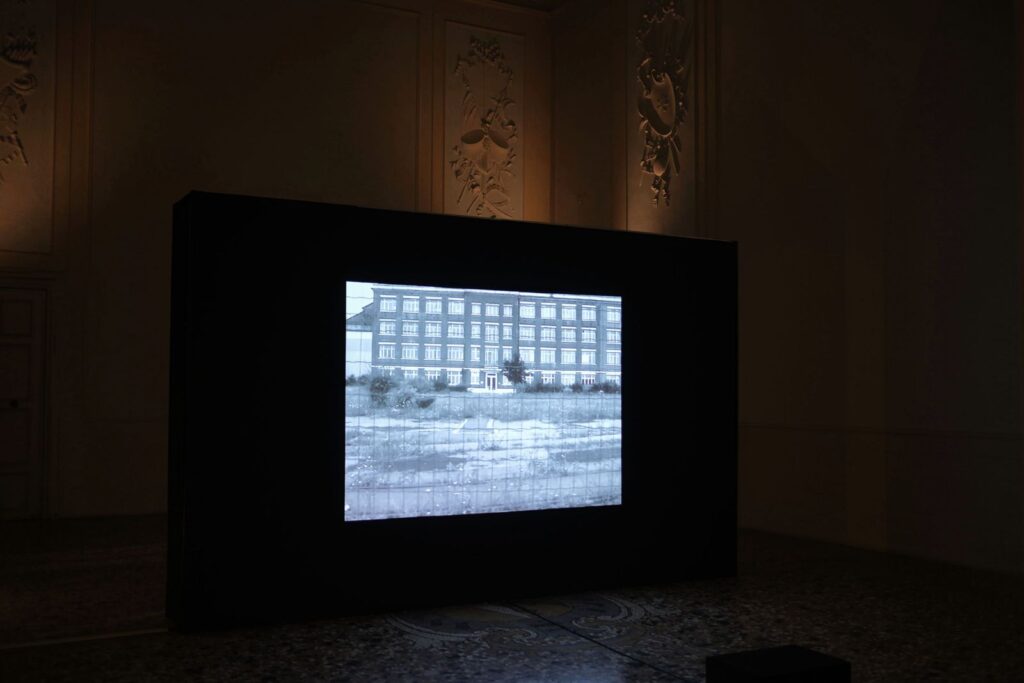
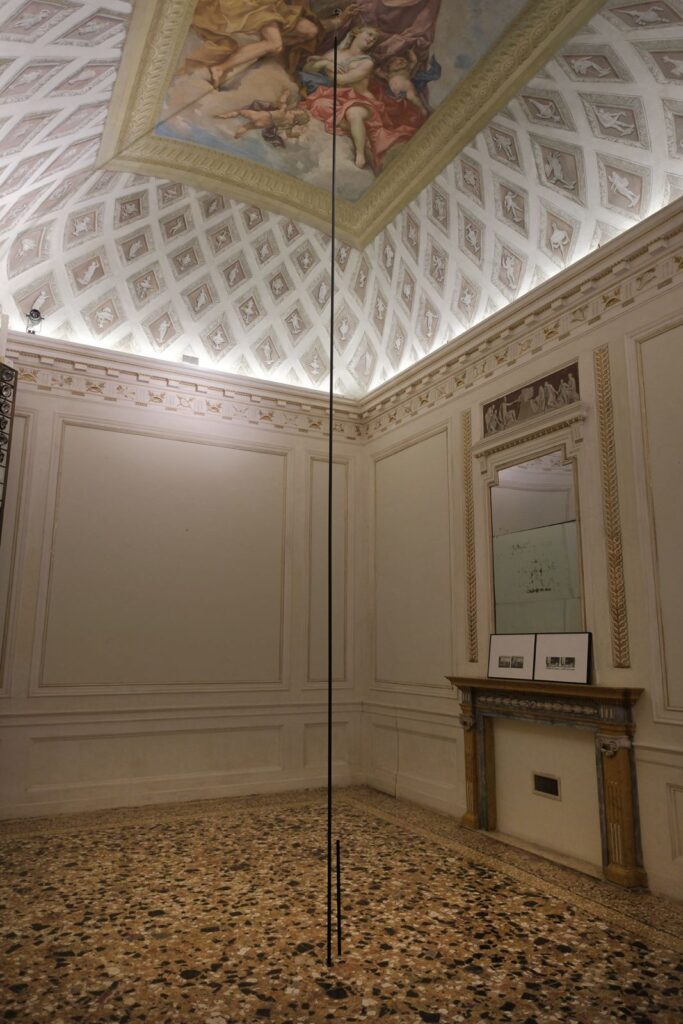
Ph. 1 Peter Downsbrough, POWER/ FROM, TO, WITH. 1986/2025, Wall piece, black adhesive tape and letters, variable dimensions. Installation view, The Then About As Until by Video Sound Art in the context of ArtVerona XX edition, Palazzo Forti, Verona, 2025. Ph. Ennevi Foto.
Ph. 2 Peter Downsbrough, THE OTHER, 2024, Video, b/w, sound, 1′ 45”. Installation view, The Then About As Until by Video Sound Art in the context of ArtVerona XX edition, Palazzo Forti, Verona, 2025. Ph. Ennevi Foto.
Ph. 3 Peter Downsbrough, Two Pipes, One Standing – 27.5 cm, 2021 Room piece, two black-painted metal pipes, variable dimensions. Installation view, The Then About As Until by Video Sound Art in the context of ArtVerona XX edition, Palazzo Forti, Verona, 2025. Ph. Ennevi Foto.
Manon de Boer
Oumi. From nothing to something to something else, part 3
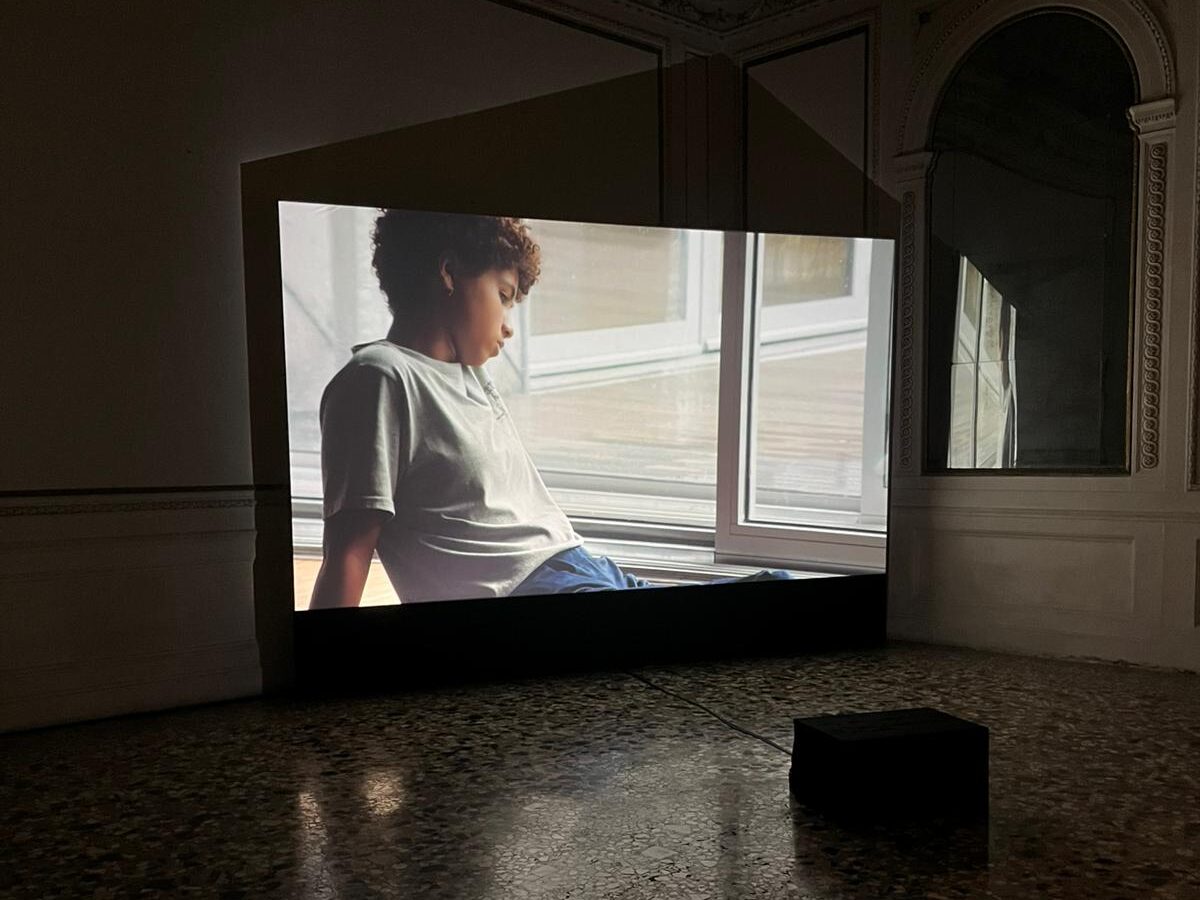
Manon de Boer, Oumi. From nothing to something, to something else, part 3, 2019, Video HD, color, 15’. Installation view, The Then About As Until by Video Sound Art in the context of ArtVerona XX edition, Palazzo Forti, Verona, 2025.
Discover more about the work
Much of Manon de Boer’s work (b. 1966, Kodaikanal, India) is based on the rupture between sound and image. In her films the visual image and the soundtrack can function as independent narratives, generating a space of ambiguity in which verbal language, movement and silence acquire a deep resonance. Oumi is the third and final part of From nothing to something to something else, a series of three
portraits of adolescents. In Oumi, we see a girl who plays with the objects around her. The intimate, sensory and sonic presence of her breathing and voice contrasts with the feeling of witnessing an inner world to which we have no access. In the trilogy’s videos, the adolescents were invited to experiment with sound, interact with space or simply do nothing, exploring the lapse of time between the already and the not yet, the time of potential.
Anouk De Clercq e Helga Davis
OK
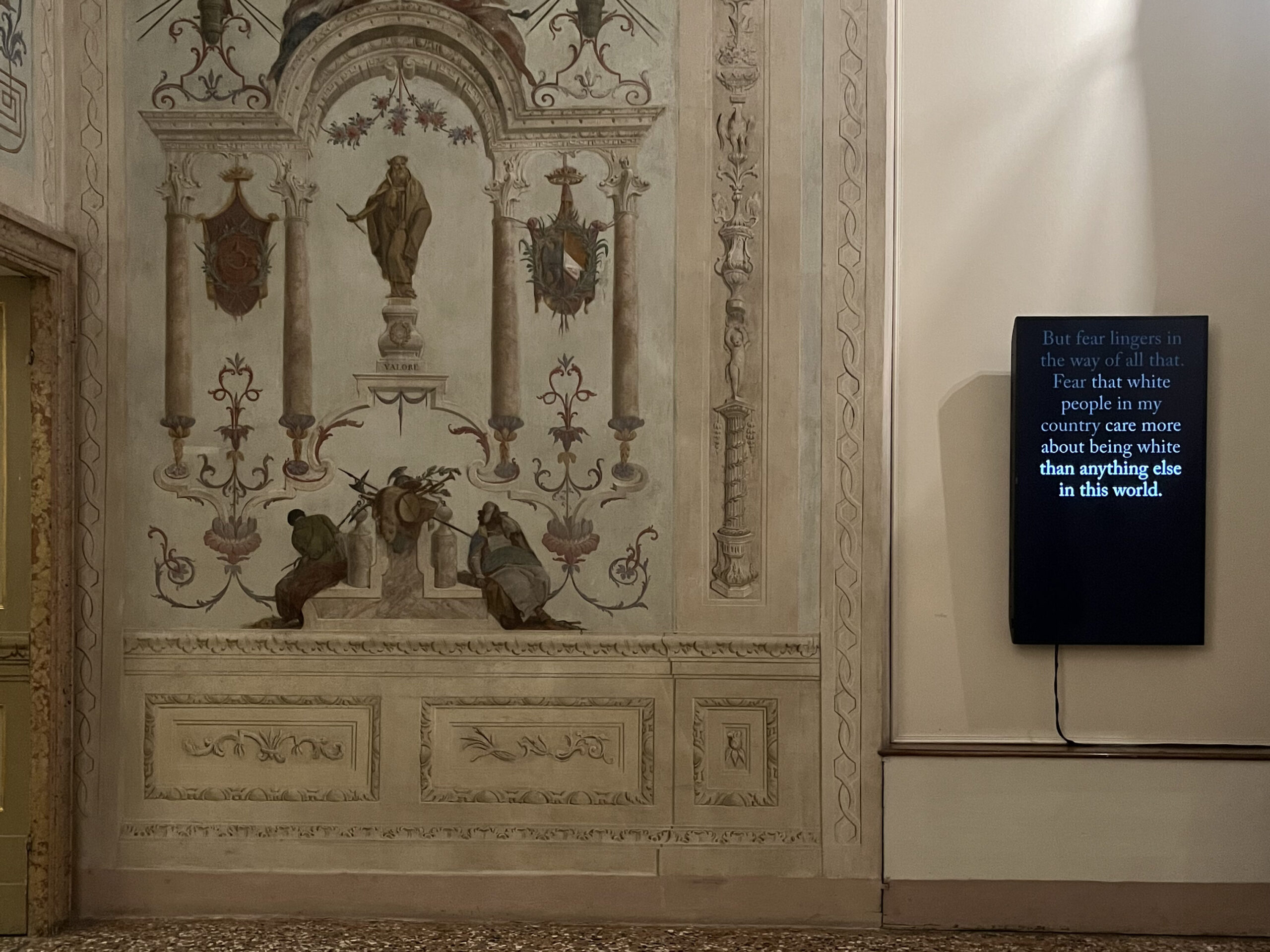
Anouk De Clercq e Helga Davis, OK, 2021, Video, b/n, 5’. Installation view, The Then About As Until by Video Sound Art in the context of ArtVerona XX edition, Palazzo Forti, Verona, 2025.
Discover more about the work
Anouk De Clercq (b. 1971, Ghent, Belgium) is a multidisciplinary artist whose work explores the intersections between cinema, music and architecture. Drawing on her training in music and film, she creates audiovisual experiences that challenge traditional notions
of narrative and perception. The work OK stems from a collaboration with the New York–based artist, writer and composer Helga Davis, who in the summer of 2020, at the height of the Black Lives Matter protests, wrote a text to give voice to her pain and also to her hopes for the future. The text became the starting point for a new film and a first joint work signed by Helga Davis and Anouk De Clercq.
OK is a personal account on the relationship between white and black, exploring the possibility of collaboration and mutual care. The work questions dynamics of power and responsibility inherent in any relationship, in search of a shared essence between opposites.
Nicoletta Grillo
Oltremare
Napoli Stazione Marittima / Buenos Aires Hotel de Inmigrantes
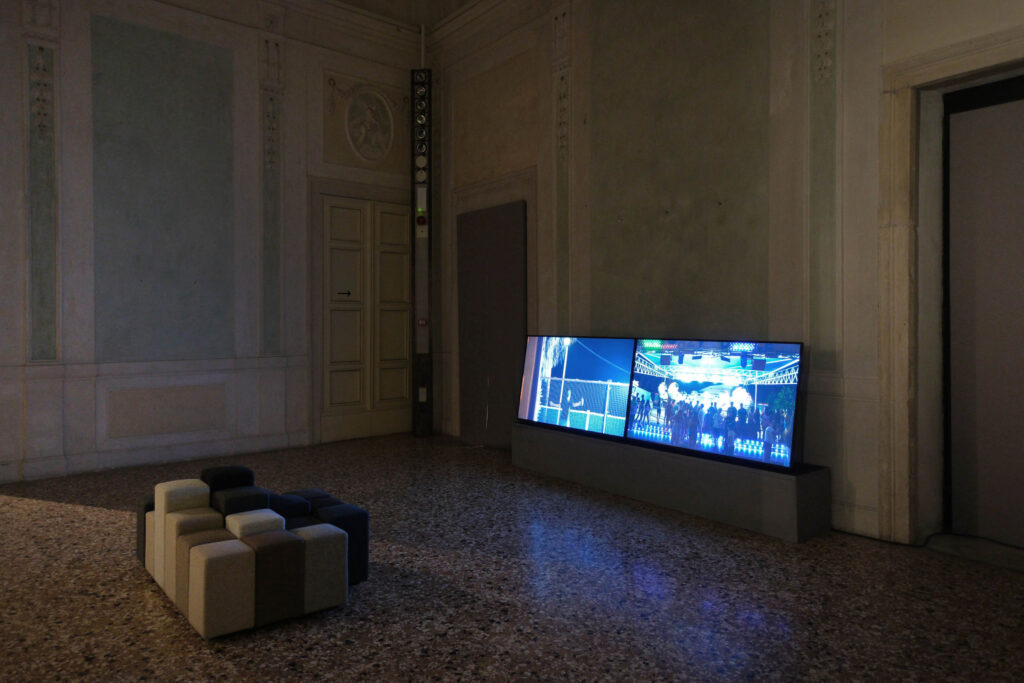
Nicoletta Grillo, Oltremare, 2025, Two-channel video, 4k UHD, sound, colour, 16 min. Installation view, The Then About As Until by Video Sound Art in the context of ArtVerona XX edition, Palazzo Forti, Verona, 2025. Photo by Ennevi Foto.
Discover more about the works
Oltremare is a video work made on the Tyrrhenian coast of Calabria. The video explores movements and displacements between land and sea in a landscape where departure is both a historical condition and an almost existential element. Rooted in the artist’s family biography, the video traverses the past and present of this area: from the geological movements of an environment once covered by
water, to recent human migrations. Oltremare develops a visual narrative that speaks of belonging and a desire to overcome, intertwining personal memories with the collective history of a territory. Two voices dialogue on memories of emigration while the surrounding environment appears in the foreground on the screens. The rhythm of the machinery at the port of Gioia Tauro recalls the flow of a community in constant movement, while the silence of abandoned places contrasts with the noise of young people who now inhabit the coastal town.
Also on display is Napoli Stazione Marittima / Buenos Aires Hotel de Inmigrantes. The work relates two geographic and symbolic poles of Italian migration between the late 19th and early 20th centuries: the Stazione Marittima in Naples, a departure point for many emigrants from Southern Italy, and the Hotel de Inmigrantes in Buenos Aires, a facility that accommodated migrants for sanitary checks in the first days after their arrival in Argentina. The ceramic model reproduces the Argentine port building constructed at a time when the country urgently needed foreign labor. The work also draws on the artist’s personal history: a paternal aunt who emigrated to Argentina, a figure evoked in the video Oltremare included in the exhibition. The ceramic rests on a photographic print depicting the Stazione Marittima in Naples, the main departure point for ocean‐bound steamships. The work also connects ideally to the images of the port of Gioia Tauro present in Oltremare, creating a system of cross‐references between past and present, historical and contemporary migration.
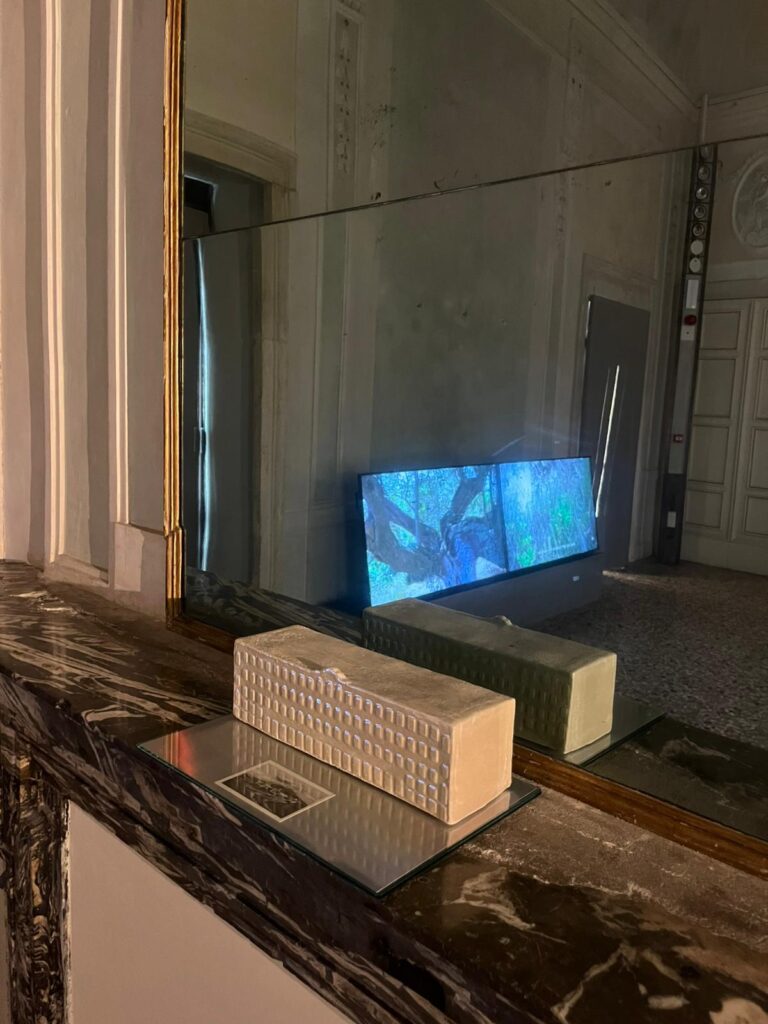
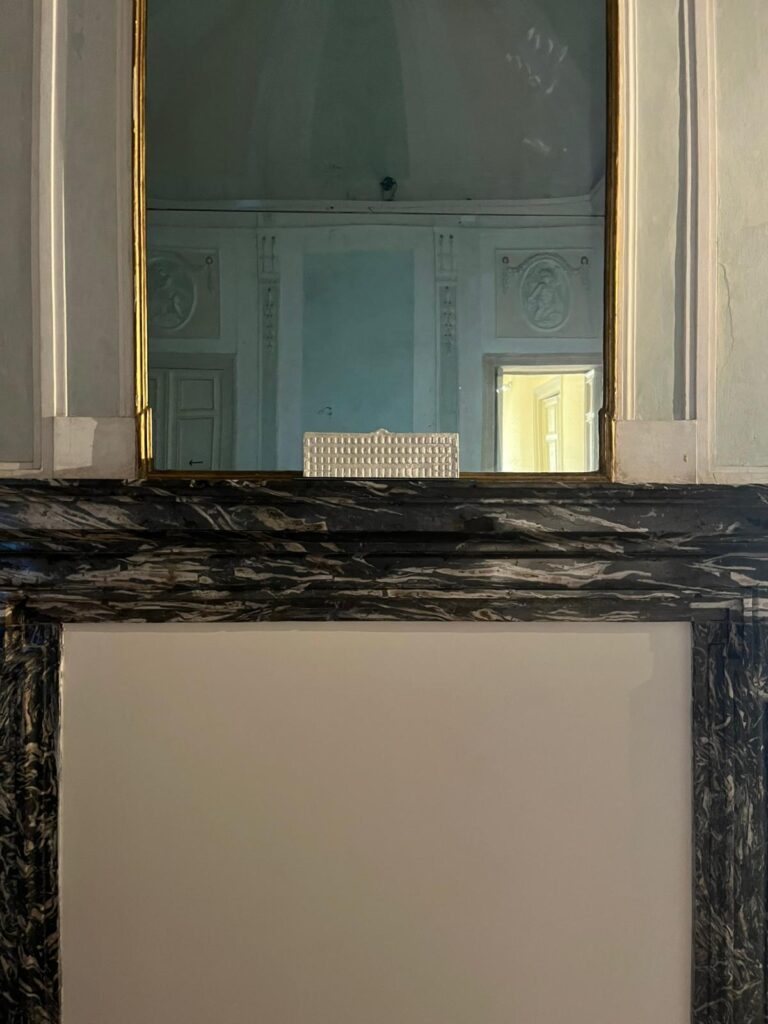
Nicoletta Grillo, Napoli Stazione Marittima / Buenos Aires Hotel de Inmigrantes, 2025, Ceramic, glass, print on photographic paper, 33 x 23 x 11 cm. Ceramic made by Tami Izko. Installation view, The Then About As Until by Video Sound Art in the context of ArtVerona XX edition, Palazzo Forti, Verona, 2025.
Anouk De Clercq
Birdsong
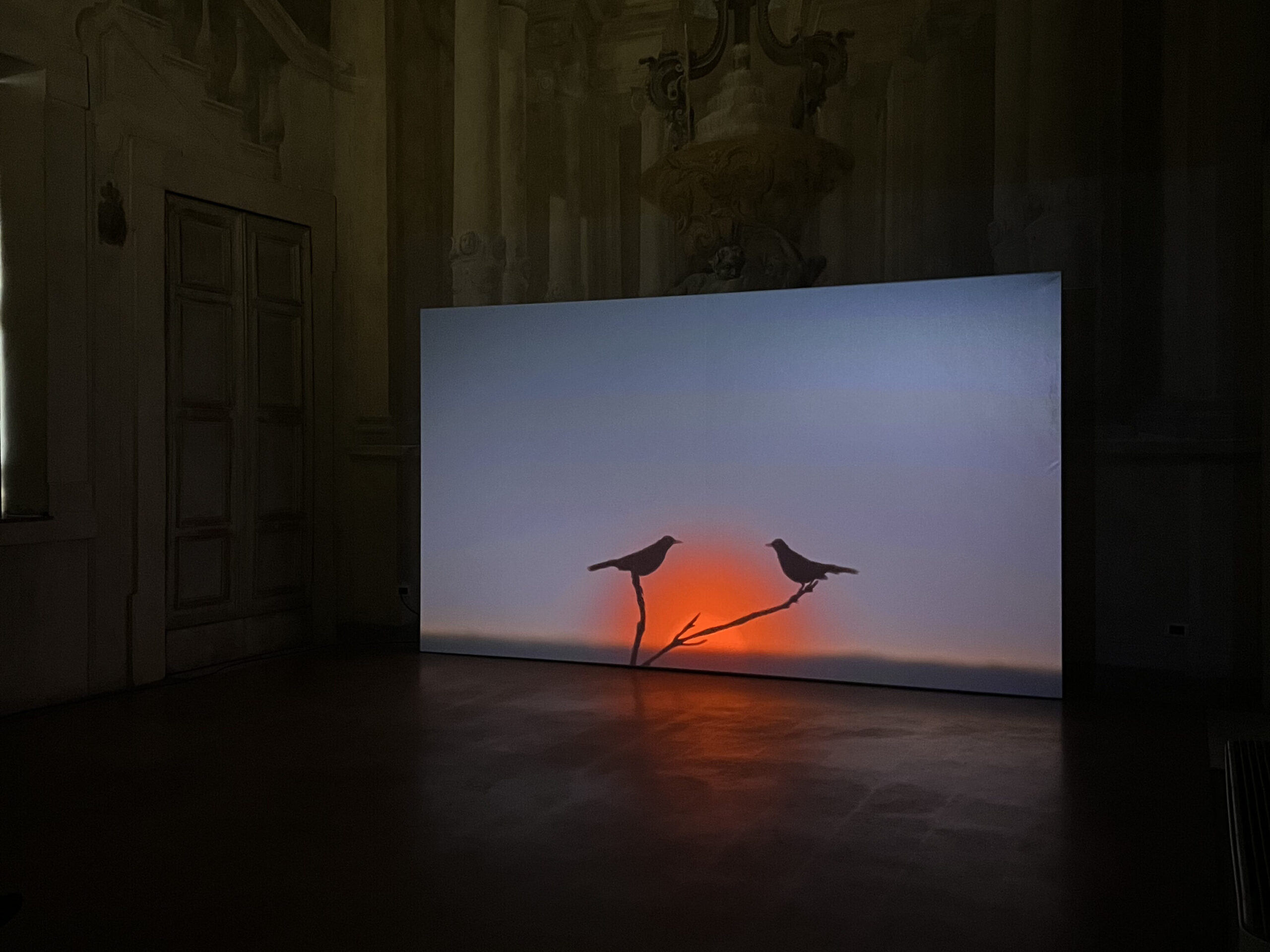
Anouk De Clercq, Birdsong, 2023, Video, color & b/w, 16’ 30”. Installation view, The Then About As Until by Video Sound Art in the context of ArtVerona XX edition, Palazzo Forti, Verona, 2025.
Discover more about the work
De Clercq’s practice is distinguished by a deep interest in the poetic potential of moving images. Her works often focus on imagined and utopian landscapes that come to life through a combination of digital techniques and analog sensitivity. In Birdsong, two birds in a weightless world invoke the sun with a song until an eclipse makes the stars appear. Birdsong attempts to glimpse a beginning within an ending – a meditation on a world without us, a paradise beyond humanity, a kind of love at first sight. By removing superfluous detail, De Clercq invites the viewer into contemplative spaces that blur the borders between physical and virtual, visible and imaginary.
David Claerbout
The Pure Necessity
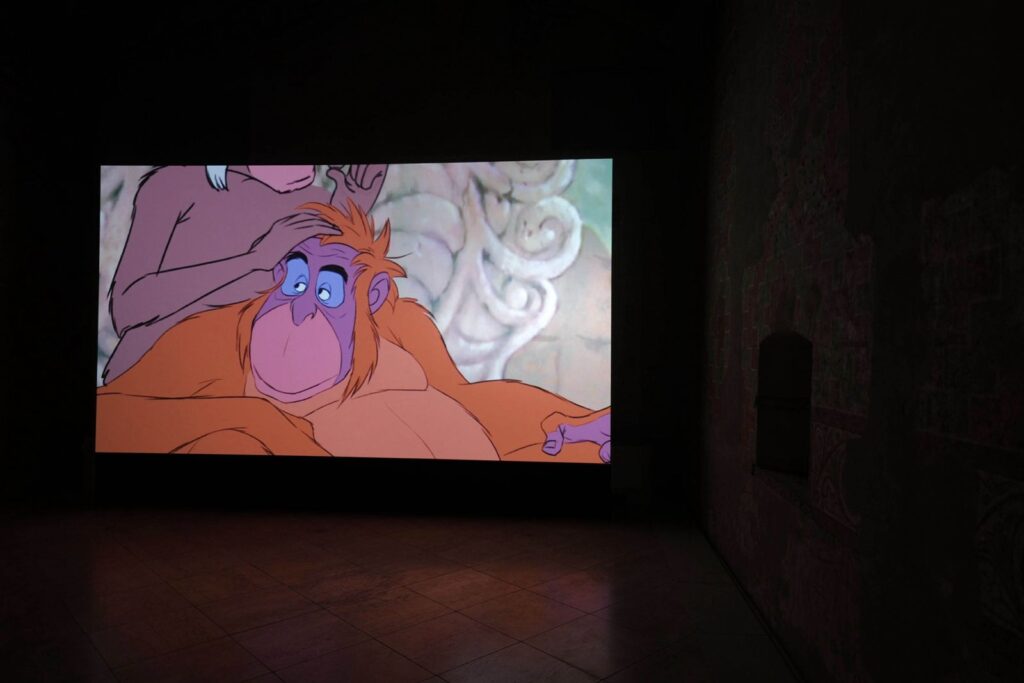
David Claerbout, The Pure Necessity, 2016, Video HD, color, sound, 50’. Installation view, The Then About As Until by Video Sound Art in the context of ArtVerona XX edition, Palazzo Forti, Verona, 2025. Ph. Ennevi Foto.
Discover more about the work
David Claerbout (b. 1969, Kortrijk, Belgium) is one of the most innovative and acclaimed artists working with moving images. His practice sits at the intersection of photography, cinema, video, 3D, digital technology and new media. Although trained as a painter, Claerbout has progressively turned, through photography and video, to the exploration of the concept of time and duration.
In The Pure Necessity, assisted by a team of professional animators, Claerbout reclaims the characters and settings from Walt Disney’s animated film The Jungle Book, freeing them from all forms of language and anthropomorphic reference, in an operation that subtracts human faculties. The animals, instead of speaking, singing and dancing, return to being bears, panthers and pythons, showing us an alternative methodology of listening, dialogue and representation of the living.
Performance
The exhibition was accompanied by a performance programme that featured two sound interventions from the project It sounds like another word curated by Nicola Giuliani (Campo Base Project) and the performance Utopia Gym curated by Marilisa Cosello.
It sounds like another word
Neuf Voix; Giulia Rae, Mira; AGUA VIVA, Martina Amæmi, Davide Salvan at the Acusmonium Odae
curated by Nicola Giuliani
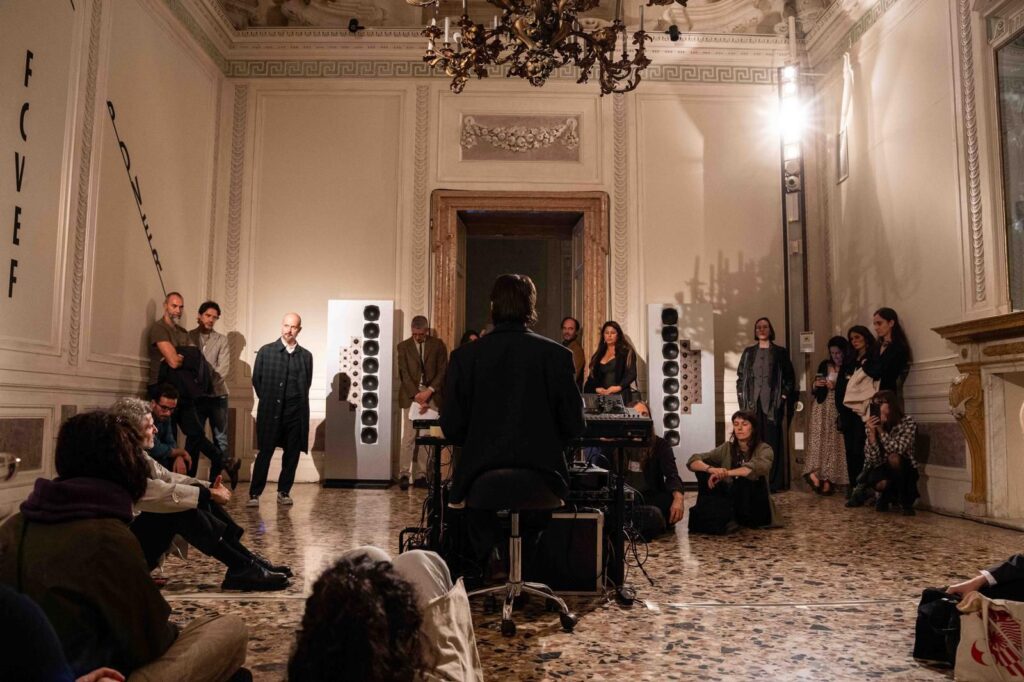
Neuf Voix at Acusmonium Odae. Sound performance from Nicola Giuliani’s project It sounds like another word during the exhibition The Then About As Until by Video Sound Art in the context of ArtVerona XX edition, Palazzo Forti, Verona, 2025. Photo by Ennevi Foto.
Discover more about the performance
The Acusmonium Odae, both a work of art and a musical instrument (handmade by the artist Neuf Voix), will temporarily occupy the exhibition spaces, dialoguing with Peter Downsbrough’s POWER/ FROM, TO, WITH. Neuf Voix will perform at the Acusmonium, presenting pieces from their latest work Music for Dimensions, which challenges the conventions of traditional listening by exploring the infinite potential of sound through the digitization of the voice. Concrete music, made of crisp electronic sounds transformed into new acoustic landscapes, will guide us in a continual tension between past and future, between real and imaginary, between tradition and avant‐garde.
The C3 collective, a space for experimentation and an independent laboratory focused on the recovery of sonological skills, acoustic ecology, sound experimentation and acusmatic interpretation, proposes a selection of five young artists in dialogue with one another who will perform at the Acusmonium – Giulia Rae, Mira, AGUA VIVA, Martina Amæmi, Davide Salvan – operating at the intersection of acusmatic aesthetics and live performance, and able to create activations also at the bodily, gestural and visual level.
Utopia Gym
curated by Marilisa Cosello
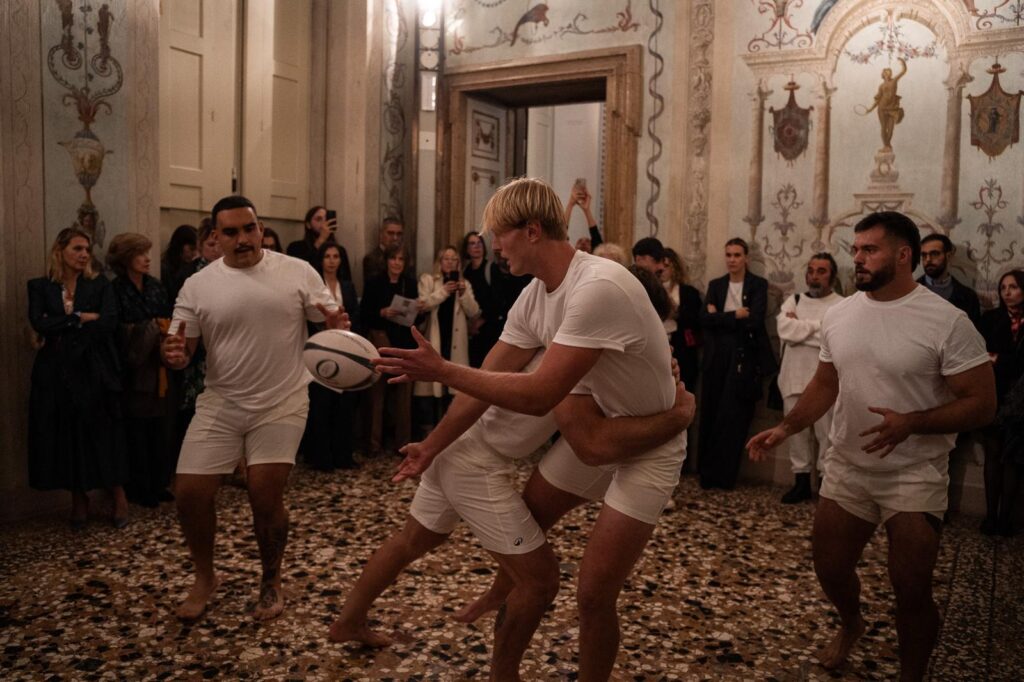
Performance Utopia Gym curated by Marilisa Cosello, on the occasion of the exhibition The Then About As Until by Video Sound Art in the context of ArtVerona XX edition, Palazzo Forti, Verona, 2025. Photo by Ennevi Foto.
Discover more about the performance
In Marilisa Cosello’s (b. 1978, Salerno) performance Utopia Gym the athletic body becomes sign and language. Sporting gestures are transformed into a corporeal alphabet that communicates through shapes, tensions and stasis, elaborating a syntax of movement where each athletic position assumes semantic and narrative value. The artist places at the center of her performances a profound reflection on the body as a territory of individual and collective meanings.
Bodies in performance enter the exhibition context establishing formal and conceptual relationships with the works on display. Athletes from different sports disciplines become protagonists of a performance where each gesture, each position maintained for long minutes, is charged with aesthetic and symbolic values. Thus a system of correspondences is generated in which the athletes’ physical presence redefines the perception of the exhibition space and of the works themselves, activating new readings and meanings. The sporting sequences evoke the great Venetian sculptural tradition — from Antonio Canova to the masters of marble — creating a temporal bridge between classical art and contemporary practice.
The project was developed in collaboration with Fondazione Bentegodi and Rugby srl ssd.
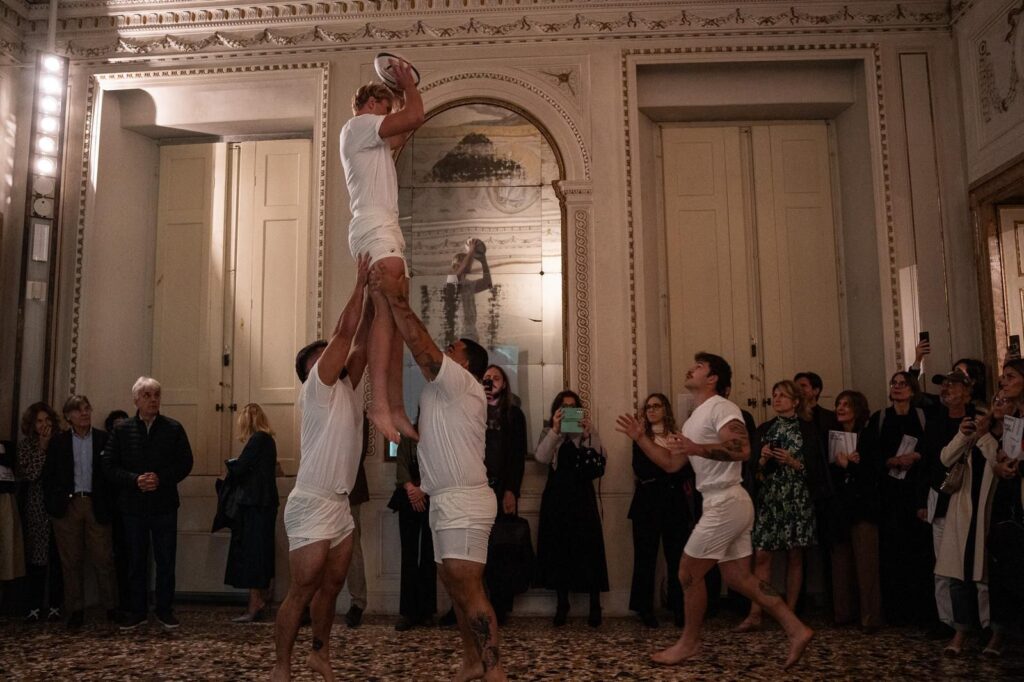
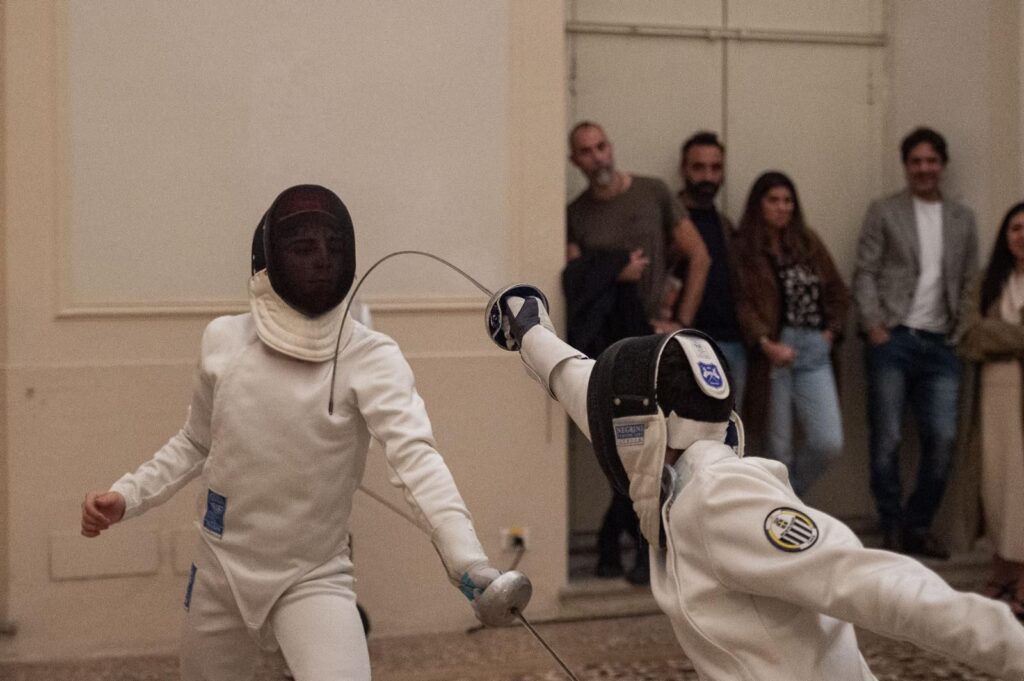
Performance Utopia Gym curated by Marilisa Cosello, on the occasion of the exhibition The Then About As Until by Video Sound Art in the context of ArtVerona XX edition, Palazzo Forti, Verona, 2025. Photo by Ennevi Foto.
The Then About As Until
9 – 26 October 2025
Palazzo Forti
Volto Due Mori, 4, Verona
Curated by
Laura Lamonea
Exhibition Hours:
Thursday, October 9 – 8:00 PM to 11:00 PM
Friday, October 10 – 11:00 AM to 9:00 PM
Saturday, October 11 – 11:00 AM to 7:00 PM
From 8:00 PM – Opening event (by invitation only)
Sunday, October 12 – 11:00 AM to 7:00 PM
Also open on:
October 17–19 and October 24–26, from 11:00 AM to 7:00 PM
Performances | Program:
Saturday, October 11
→ 8:00 PM (by invitation only)
Utopia Gym – Performance by Marilisa Cosello
→ 8:30 PM (by invitation only)
Neuf Voix – at Acusmonium Odae
Part of the It Sounds Like Another Word program,
curated by Nicola Giuliani (Campo Base Project)
Sunday, October 12
→ 11:00 AM – 2:00 PM (free admission)
Giulia Rae, Mira; AGUA VIVA, Martina Amæmi,
Davide Salvan – at Acusmonium Odae
Curated by C3
Part of the It Sounds Like Another Word program,
curated by Nicola Giuliani (Campo Base Project)
In collaboration with:
ArtVerona
Supported by:
Embassy of Belgium
Curatorial Assistant
Francesca Mainardi e Federica Torgano
Production
Lino Palena