Screening program | XVI edition
Fondazione Galleria Milano
19-22 November 2026
Screening program
Thursday 19 november
• h 18:00 · Screening of films from the CNAP – Centre national des arts plastiques, Paris
Uriel Orlow, Imbizo Ka Mafavuke (Le Tribunal de Mafavuke)
Thomas Hirschhorn, Deleuze Monument
Florence Lazar, 125 hectares
Jordi Colomer, Medina – Parkour
Randa Maroufi, Le Park
Meriem Bennani, Party on the CAPS
• h 20:16 Haig Aivazian, You May Own the Lanterns but We Have the Light
• h 21:01 Nicola Pellegrini e Ottonella Mocellin, Alphabet. The space between us and the unknown
• h 21:32 Caterina Erica Shanta, En Ausencia
Friday 20 november
• 18:00 Nicola Pellegrini e Ottonella Mocellin, Alphabet. The space between us and the unknown
• 18:30 · Ugo La Pietra screening:
La grande occasione
La riappropriazione della città
Il monumentalismo
Per oggi basta! (il Commutatore)
Interventi pubblici per la città di Milano (Paletti e catene)
• 21:00 · Uriel Orlow, Imbizo Ka Mafavuke (Le Tribunal de Mafavuke)
• 21:30 · Thomas Hirschhorn, Deleuze Monument
Saturday 21 november
• 12:00 · Ila Bêka e Louise Lemoine, 24 heures sur place
• 13:30 · Uriel Orlow, Imbizo Ka Mafavuke (Le Tribunal de Mafavuke)
• 14:00 · Thomas Hirschhorn,Deleuze Monument
• 14:30 · Florence Lazar, 125 hectares
• 15:04 ·Jordi Colomer, Medina – Parkour
• 15:08 ·Randa Maroufi, Le Park
• 15:22 · Caterina Erica Shanta, En Ausencia
• 17:00 · Ugo La Pietra, Il monumentalismo e Interventi pubblici per la città di Milano (Paletti e catene)
• 17:19 · Nicola Pellegrini e Ottonella Mocellin, Alphabet. The space between us and the unknown
• 19:00 · Ugo La Pietra, La riappropriazione della città, La grande occasione e Per oggi basta! (il Commutatore)
• 20:00 Haig Aivazian, You May Own the Lanterns but We Have the Light
• 20:45 ·Marta Innocenti, L’Assedio
Sunday 22 november
• 11:00 Screening of films from the CNAP – Centre national des arts plastiques, Paris
Uriel Orlow, Imbizo Ka Mafavuke (Le Tribunal de Mafavuke)
Thomas Hirschhorn, Deleuze Monument
Florence Lazar, 125 hectares
Jordi Colomer, Medina – Parkour
Randa Maroufi, Le Park
Meriem Bennani, Party on the CAPS
• 13:16 · Haig Aivazian, You May Own the Lanterns but We Have the Light
• 14:00 · Marta Innocenti, L’Assedio
• 14:52 · Ugo La Pietra screening:
La grande occasione
La riappropriazione della città
Il monumentalismo
Per oggi basta! (il Commutatore)
Interventi pubblici per la città di Milano (Paletti e catene)
• 16:09 · Randa Maroufi, Le Park
• 16:23 · Jordi Colomer, Medina – Parkour
• 16:26 · Ila Bêka e Louise Lemoine, The World in a square
• 19:00 · Nicola Pellegrini e Ottonella Mocellin, Alphabet. The space between us and the unknown
• 19:29 · Caterina Erica Shanta, En Ausencia
• 21:00 · Haig Aivazian, You May Own the Lanterns but We Have the Light
Synopsis
CNAP – Centre national des arts plastiques
Tra i film in programma, una selezione di opere provenienti dalla collezione del Centre national des arts plastiques (Cnap) di Parigi, collezione ministeriale francese nata durante la Rivoluzione francese, frutto della ricerca sviluppata dalla curatrice Laura Lamonea nel 2023.

Meriem Bennani
Party on the CAPS
2018
Video HD, color, sound, 25’08”
Party on the CAPS takes place in a world transformed by biotechnological progress and teleportation, which has become the new means of transportation. A crocodile named Fiona recounts life on CAPS, an island located in the middle of the Atlantic Ocean, where refugees and immigrants who have crossed seas and borders in a manner deemed “illegal” are detained by the state.
Jordi Colomer
Medina – Parkour
2013
Video HD, color, silent, 3’05’’
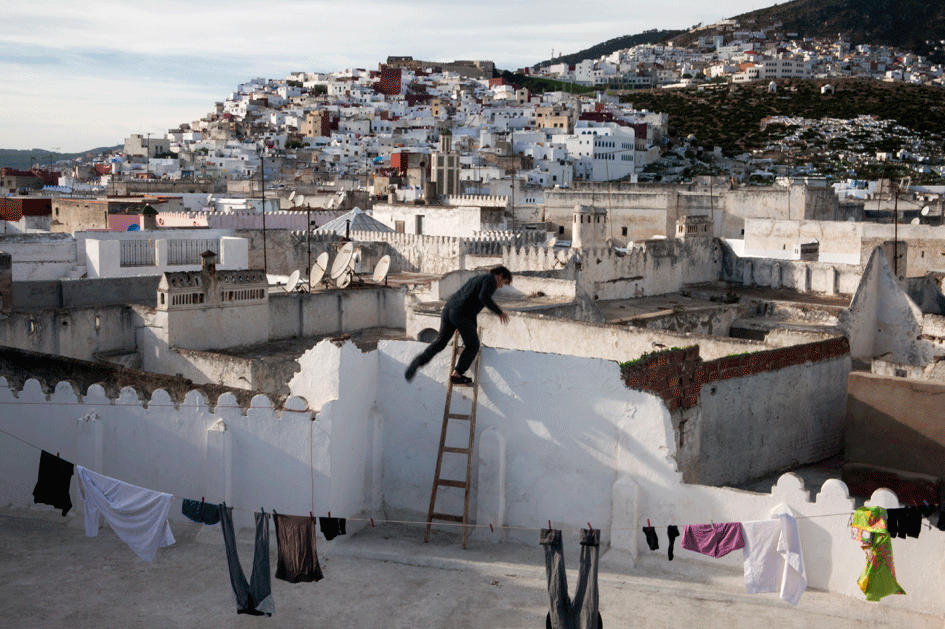
The work was created during the artist’s residency in Tetouan (Morocco), the former capital of the Spanish protectorate. The artist stages himself on the rooftops of the medina of Tétouan. The temporary nature of the medina, inherent in its urban layout, also influences the multiplicity of forms and narratives that structure it. Colomer offers a reflection on the limits and uses of a space governed by unwritten laws.

Thomas Hirschhorn
Deleuze Monument
2000
Video Betacam SP, 30’22”
Deleuze Monument documents the project created by Thomas Hirschhorn in the Cité Champfleury neighborhood of Avignon, dedicated to the philosophy of Gilles Deleuze. Through the construction of a temporary monument and the direct involvement of residents, the video reflects on public space and community participation. The monument becomes a relational device, capable of fostering dialogue, sharing, and the collective production of meaning.

Florence Lazar
125 hectares
2019
Video HD, color, sound, 33’25”
125 hectares is the area of land that has been illegally occupied since 1983 by a farmers’ collective in Morne-Rouge, in northern Martinique. Véronique Montjean, a founding member of the collective, recounts the history of the occupation, which began as a response to real estate development projects that would have reduced the island’s arable land. The collective promotes subsistence farming based on biodiversity through the rotation of local crops, opposing the banana monoculture imposed by France, which has led to the pollution of soil and rivers due to the use of carcinogenic insecticides.

Randa Maroufi
Le Park
2015
Video HD, color, sound, 14’
Le Park is a slow stroll through an abandoned amusement park in the heart of Casablanca (Morocco). The film focuses on the young people who frequent this place. Randa Maroufi’s camera captures, by surprise, groups of young people engaged in various activities, their movements seeming frozen in time.

Uriel Orlow
Imbizo Ka Mafavuke (Le Tribunal de Mafavuke)
2017
Video HD, color, sound, 29’52”
The film is an experimental documentary set on the outskirts of a nature reserve in Johannesburg. It depicts the preparations for a people’s tribunal in which traditional healers, activists and lawyers come together to discuss indigenous knowledge and bioprospecting. The pharmaceutical industry has come to regard traditional medicine as a source for identifying new bioactive compounds that can be used in the development of synthetic drugs. The film’s protagonists take on different roles, whilst the ghosts of colonial explorers, botanists and judges observe the debates.

Haig Aivazian
You May Own the Lanterns but We Have the Light
Ep. 1: Home Alone, 2022, 12’36’’
Ep. 2: Eyeshadow Dark as Night, 2024, 10’43’’
Ep. 3: Children of Darkness, 2025, 20’35’’
The trilogy You May Own the Lanterns, but We Have the Light consists of black-and-white short films created from cartoons and found footage, which have been redrawn, assembled and reanimated in collaboration with a team of animators in Beirut. The various sequences paint a picture of a city shrouded in darkness, where the inhabitants seek refuge in various forms of escapism. Drawing inspiration from the history of public lighting, the work considers artificial light not only as a means of illuminating the streets at night, but also as a mechanism of governance, in which visibility underpins surveillance, authority, and the staging and maintenance of social order in public space.

Ila Bêka, Louise Lemoine
The World in a square
2026
Video HD, color, sound, 72’
At first glance, Iman, Peter, Johanne, Kala and Elisa seem to have little in common. Political activism, astronomy, tattoos, cooking and babysitting are worlds that rarely intersect. What unites them is the fact that they all live in Nørrebro, Denmark’s most socially and ethnically diverse neighbourhood. More than ten years ago, a park was created at its heart to bring the community together. Like a village square where the whole world converges, Superkilen quickly became a landmark and a vibrant hub of civic life. Over the course of a summer, Bêka & Lemoine set up camp in the park to observe this global microcosm from within. In the film, they explore how the neighbourhood is shaped by migration, religion and politics, and examine how an intervention designed for a specific context can foster coexistence and enable people to collectively inhabit and redefine a shared space.

Ila Bêka, Louise Lemoine
24 heures sur place
2014
Video HD, color, sound, 90’

Marta Innocenti
L’Assedio
2021
52’
L’Assedio explores the wild, collective, and transgressive ritual that draws over 200,000 spectators each year to the fields surrounding the Mugello Circuit during the Italian MotoGP Grand Prix. The film examines the tension between the freedom of breaking the rules and the limits imposed by the high barriers that surround the circuit.

Ugo La Pietra
Il monumentalismo
1974
Film 16 mm, b/w, sound, 13’
Filmed ‘inside and outside’ Milan Central Station, it uses this architecture as a model to reveal that, in the environment in which we live, there is almost never a relationship between space and its use. Identifying this ‘disconnect’ means expressing a critical stance towards architecture that refuses to embrace any ‘vital’ aspect, reducing itself to a ‘monumental structure’ incapable of accommodating the dynamics of human relationships.

Ugo La Pietra
Interventi pubblici per la città di Milano (Paletti e catene)
1979
Ed. Triennale di Milano, film 16 mm, color, sound, 4:3, 6’29’’
The video work is a metaphorical critique of Milan’s urban planning stagnation in the late 1970s. La Pietra features street objects and elements—bollards, posts, and chains—as symbols of a city that fails to break out of its own limitations and does not produce significant urban projects. <br/>

Ugo La Pietra
La riappropriazione della città
1977
Ed. Centre Georges Pompidou (Parigi), film 16 mm, b/w, color, sound, 4:3, 29’41’’
‘To live is to feel at home wherever you are’ is the phrase with which La Pietra begins an anthological and provocative analysis that decodes urban suburbs and self-managed spaces, denouncing the impossibility of intervening in urban space and thus describing how to reclaim the city through a mental journey.

Ugo La Pietra
La grande occasione
1973
Ed. Triennale di Milano/Abet Print, film 35 mm, b/w, sound, 4:3, 13’42’’
The film, produced to mark the 15th Milan Triennale, was shot inside the Triennale building, which, when empty, conveys the sense of tension and anticipation felt by every artist – and by an entire generation – who spend their whole lives hoping for the arrival of that ‘big break’: a major exhibition at an institutional venue.

Ugo La Pietra
Per oggi basta! (il Commutatore)
1974
Film 16 mm, b/w, sound, 14’
The film explores the difficulties the artist encounters whenever he ventures beyond an established system. This concept is represented through the creation and use of an instrument (Il Commutatore, 1970) that allows him, in successive stages, to transcend the physicality of the urban environment and project himself toward the “void.”<br/>

Ottonella Mocellin e Nicola Pellegrini
Alphabet. The space between us and the unkown
2021
29’03’’
The film stems from a reflection on the legacy of the Cold War on Asian diaspora communities in the West, while also exploring the artists’ personal relationship with Berlin’s Vietnamese community—composed of two groups of people who arrived from a divided country to a divided country, and thus particularly symbolic of this legacy. By portraying their experience as Italian adoptive parents of a daughter and a son born in Vietnam, the artists explore the intersection of belonging, kinship, history, memory, and identity politics. The film documents a performance in an urban setting: traveling on a small boat, the artists and their family spend an intimate day in a public space, navigating Berlin’s city traffic in search of an imaginary place where the lives of those who have been divided by history might ideally come together.

Caterina Erica Shanta
En Ausencia
2021
26’
In Central America, water is often contaminated and drinking water is a private commodity, governed by market forces just like any other commodity. The film was conceived and shot during Caterina Erica Shanta’s research residency in Mexico City in June 2023. To highlight the political nature of water in Mexico, the artist launched an open call inviting people to share their dreams in which water featured as the main and recurring element. The film is therefore built around the narrations of those who took part in the project, recounting dreams of water – both marvellous and terrifying omens – set against the backdrop of the Xochimilco marshes, the last remnant of the immense Lake Texoco, which disappeared after the 1960s.